Short Stories and Essays
- The Traditional Family, An Endangered Species
- My First Encounter With a Living Prophet
- John the Baptist, Our Elias-Assignment, and the Word of Wisdom
- A Strange Twist
- Rejoicing in the Accomplishments of Others
- It Takes More Than One Breath for This Jump
- Our Unplanned Trek from Bald Knob to Firetower Road
- A Christmas Story from World War II
- My Clemson Basketball Experience (Freshman Year 1965-1966)
- A Short Essay About Chiasmus
CLICK FOR NEXT INDEX PAGE
A CHRISTMAS STORY FROM WORLD WAR II
[John E. Enslen wrote this story on December 26, 2022 and posted it on Facebook that morning.]
I know that I am a day late for a Christmas story, but just in case the freezing weather or other circumstances prevented you from sharing a Christmas story with your family this year, I want to provide you with this one. It is never too late to read a good story to your spouse and children, if they are still awake.
This is a true Christmas story about an unusual Christmas gift. It involves, literally, a merciful gift of life and peace, given under extremely unique circumstances. It was a gift that owes its origin to the givers’ and the receivers’ common belief in the traditional celebration of Christmas as practiced in their two respective nations.
The event I recount took place on Christmas Eve in 1944 during World War II. It involved a 20-year-old merchant marine whose name is Lee Wayne Maloy and all of his fellow merchant marines on board an American liberty ship. The ship had completed its delivery of war material to our soldiers in Europe and was headed back to the eastern shore of the good old USA. Victory over Germany was less than 4 1/2 months away.
I was personally intrigued by this story when I read it because during this story’s exact time period, my father was a merchant marine aboard a liberty ship which had just delivered its war material to our soldiers in the Philippines.
As a further backdrop to this story, I need to mention a World War II fatality statistic which is not well known and recognized among our general populace. There were about 243,000 merchant mariners who served in the war, and 9,521 perished while serving—a higher percentage than any combat branch of the US military—even higher than the air force which lost its pilots and crews in bombing raids over Europe; even higher than the infantry which lost its foot soldiers and paratroopers in German occupied territories; even higher than the marines which lost its beach-landing riflemen and machine gunners on a long chain of Japanese-occupied Pacific islands.
There was one basic reason for the high loss of life for merchant marines: German U-Boats—small, stealthy submarines whose deadly accurate torpedoes could easily destroy helpless, lightly armored liberty ships designed only to carry large amounts of cargo. Risk was especially high when those liberty ships were alone, unescorted by destroyers or air cover. The bodies of more than 9,000 merchant marines found their final resting place at the bottom of the ocean.
Maloy’s liberty ship was exiting the Mediterranean Sea through the Straits of Gibraltar located between the southern tip of Spain and the Northern tip of Morocco in North Africa. They were cruising through the same area where the great battle of Trafalgar had been successfully waged by Great Brittan’s Lord Horatio Nelson in1805. (I make footnote of that fact only because my Pinkston grandchildren and great-grandchild are direct lineal descendants of Lord Nelson—but back to Maloy’s circumstances.)
Maloy and his shipmates were traversing the open waters with thoughts of home and Christmas and family. Maloy, with binoculars in hand, was ordered to the bow for periscope-hunting duty. A periscope and its trailing “white turkey feather” were the only visible signs of the presence of a German U-Boat. But the night was stormy and dark, and the sea was covered in bouncing white caps.
Unfortunately, Maloy did not spot the stem of a protruding periscope off the port side until it was no more than 100 yards away. There was no time to take evasive maneuvers, or radio for air cover, or to protect themselves in any manner whatsoever. They knew they were facing sudden doom from the point-blank range of the feared U-Boat which was at that moment rising to the surface from the choppy sea. Their certain ill fate was sealed. The best outcome these merchant marines could possibly hope for was a warning to abandon their ship and be given enough time to enter the wintry waters in lifeboats, thus providing at least some limited chance for subsequent rescue after the abandoned ship was destroyed by torpedoes.
Maloy later recalled that he would never ever forget what happened next. Here are his own words:
“Those on the bridge must have seen the periscope at the same time I did because the ship was suddenly alive with alarms and shouts of men scurrying to their battle stations. But there was no time to ready ourselves for a fight. There was no time to protect ourselves in any way. The enemy had us dead to rights. I’ll never forget what happened next. There was a flashing: dash dash, dot dot dash dot. I mouthed the letters as I saw the German submarine blinking its Morse code message. I couldn’t believe what I was seeing. M-E-R. Could I be reading it correctly? Another “R” and then, dash dot dash dash, a “Y.” It was happening so fast as the second word flashed to us in the darkness. C-H-R-I-S-T-M-A-S. Then it was over. As fast as the U-boat had appeared it sank back into the blackness of the sea and was gone. We all stood transfixed. No one moved for several seconds as we recovered from our shock and surprise. This Christmas Eve we had been given a gift. As the reality of what had just transpired and the words “Merry Christmas” took hold in our minds and then our hearts, we unitedly sent up a cheer. A cheer of relief, and of joy and true celebration.”
This singular event stands today as an ultra-rare example of man’s humanity to man in time of war. The spirit of love, the spirit of peace, the spirit of mercy, the spirit of forgiveness, the spirit of goodwill toward all men. Yes, the spirit of Christmas, even the Spirit of Christ had prevailed. Maloy and his shipmates were able to return home, raise families, and lived productive lives.
Though now age 98, so far as I have been able to determine, Lee Wayne Maloy still lives today in South Jordan, Utah, as does his posterity, the grateful beneficiaries of a special Christmas gift from a group of German submariners who, despite every possible pressure to the contrary, voluntarily felt to follow the Savior’s soft-spoken words as set forth in Luke 6:27;31: “But I say unto you which hear, Love your enemies, do good to them which hate you…. And as ye would that men should do to you, do ye also to them likewise.”
May this continued Christmas season, and the times ahead, be a time of feeling the spirit of love, the spirit of peace, the spirit of mercy, the spirit of kindness, the spirit of forgiveness, the spirit of goodwill toward all men.
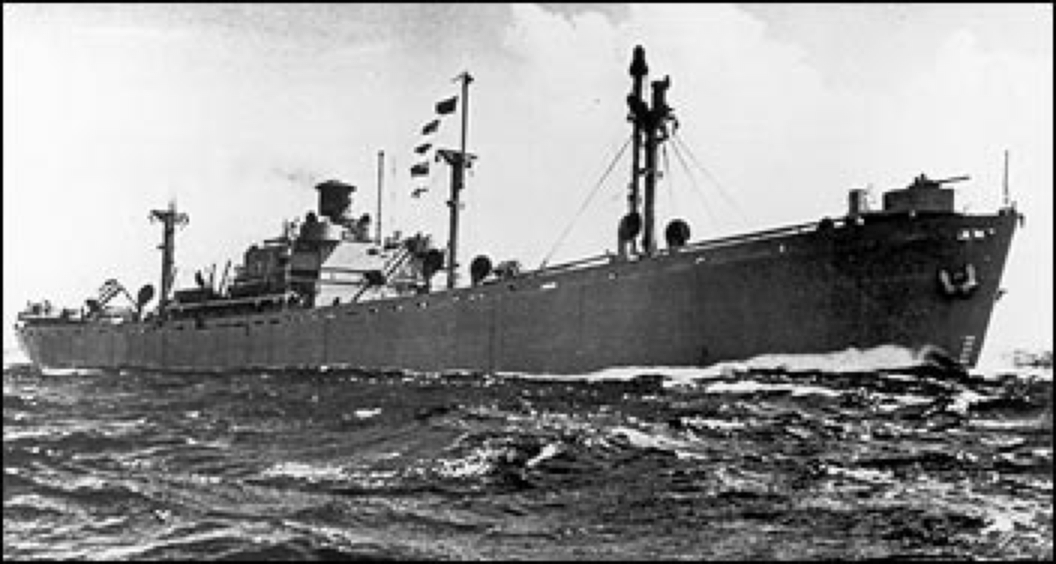
Example of an American liberty ship.