Short Stories and Essays
- The Traditional Family, An Endangered Species
- My First Encounter With a Living Prophet
- John the Baptist, Our Elias-Assignment, and the Word of Wisdom
- A Strange Twist
- Rejoicing in the Accomplishments of Others
- It Takes More Than One Breath for This Jump
- Our Unplanned Trek from Bald Knob to Firetower Road
- A Christmas Story from World War II
- My Clemson Basketball Experience (Freshman Year 1965-1966)
- A Short Essay About Chiasmus
CLICK FOR NEXT INDEX PAGE
MY CLEMSON BASKETBALL EXPERIENCE
(FRESHMAN YEAR 1965-1966)
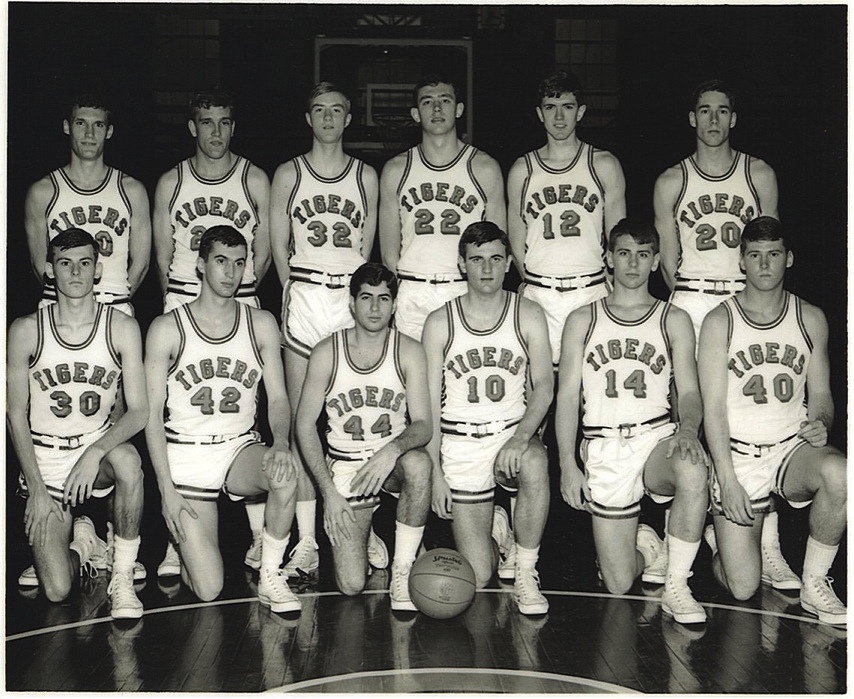
Below is a photo of our 1965-1966 freshman basketball team at Clemson University. I am No. 14 on the front row.
My freshman year, 1965-1966, I led the freshman basketball team in both free throw and field goal percentages. But I had not taken enough shots to make my accomplishments worth mentioning. In very limited play, I was 2 for 2 on foul shots and 3 for 3 on field goals—100%. For me it was a thrill to be selected for the team after a try-out period.
There were many benefits for being on the team. For one thing, it kept me in good shape. Coach Jim Brennan, in his first year as a coach, firmly believed in running us around the gym until we almost dropped—and some did drop. Playing a sport I loved, I was privileged to practice intra-squad scrimmaging almost every weekday, and to practice scrimmaging against the varsity occasionally. I had free travel and great seats to all of the freshman and some varsity basketball games in the wonderful Atlantic Coast Conference. The horrendous schedule kept me positively occupied for about four months.
I can still remember each of the three field goals that I made, as well as the two free throws. With regard to the three field goals, I had one against South Carolina, one against Davidson, and one against the Citadel. Those were the only three games in which I played.
The field goal against South Carolina came in a home game against them. We won the game in an upset. They had the nationally sought-after, highly touted, 6-feet, 8-inch-tall Mike Grosso who was intensely recruited by varsity Coach Frank McGuire to play for South Carolina.
We were ahead in the score and Coach Brennan sent me in toward the end of the game. Mike Grosso was soon taking a defensive rebound off the backboard, and I jumped as high as I could (which wasn’t all that high) and knocked the ball out of his outstretched hands before he could pull it safely into his body. I retrieved the dislodged ball from the floor and dribbled back directly under our basket where I made a fake and then immediately followed the fake with a shot against the backboard over the outstretched hands of Grosso. I was surprised my successful shot had not been blocked, but perhaps Grosso was in foul trouble by that late point in the game, and thus he was not so defensively aggressive.
I remember in that game dribbling the ball behind my back, hotdog style, when bringing the ball down the floor basically unguarded. I got some oohs and aahs from the large crowd which was sitting almost on top of us there at the field house where Clemson played their games until my junior year. Of course, the crowd was large because they were there to watch the next game—the varsity game against the cross-state archrival.
In that South Carolina game, I was later fouled and had a one and one shot. I remember, just before shooting the first foul shot, looking into the stands under the goal and seeing seated there Coach Fred Cone who had recruited me to come to Clemson. I had no relatives or hometown acquaintances in the full and overflowing stands of the Cow Palace. I felt supported by him, an Alabama native himself. I saw it in his face. I calmly sank both free throws without touching the rim.
I want to mention Mike Grosso again. Grosso was heavily recruited by Coach Frank McGuire at South Carolina. After playing freshman basketball, Grosso was disqualified from playing on the South Carolina varsity team because he had failed to score the minimum 750 on the SAT. McGuire’s disgruntled recruiting competition had looked for a way to get Grosso disqualified. Grosso scored a 789 the next time he took the SAT. He subsequently played for the University of Louisville and in the NBA.
On Saturday, February 12, 1966, the day after I met my future wife Dianne, our freshman basketball team played Davidson College at the Charlotte Coliseum. It was a Saturday, and we had about a four-hour, very slow car trip to Charlotte in the snow. I slept much of the way with my head against a cold backseat window. Perhaps that long trip contributed to our poor play that night.
Davidson’s freshman team was 10-3 going into the game and was well coached by Coach Terry Holland. The positive influence of their varsity coach Lefty Driesell was evident. Our team was ultimately embarrassed by the score of 103-68. Wayne Huckel led Davidson’s scoring with 27 points. (He would lead Davidson’s varsity in scoring the next year as a sophomore.) Davidson’s team received a loud applause when Tony Orsbon hit the 100th and 101st points for Davidson.
In the early part of the second half, Coach Jim Brennan became totally exasperated with our starting guards, Alan Goldfarb and Dave Thomas. They kept losing the ball trying to get it inside to our center, Ritchie Mahaffey. Coach Brennan sent me into the game to replace one of the guards. That was his way of making a statement to the starting guards.
I saw quickly that I would also lose the ball to a tenacious defense if I tried to force the ball inside. Someone on our team soon missed a perimeter shot. Davidson secured the rebound, took the ball down the court, and scored again. I had the privilege of bringing the ball up the court. There was no full court press, thank goodness.
I was fully confident in my outside shot, even at long range. I lived in the Fike Field House above the basketball court, the Cow Palace, at Clemson, and I spent a lot of my spare time shooting hoops. I had barely passed the half court line when I determined that I would take a shot if no one came out to guard me soon. I had steadily progressed with my dribble to a point that was still a few feet outside of the current NBA professional 3-point range. The defender had not yet begun to close the gap between us, so I suddenly stopped my dribble and threw up a long-range jump shot.
The shot could not have been any more perfect. It hit nothing but net with a loud swish. The entire stands erupted with sounds of incredibility. I am confident that I could have continued with a successful barrage of similar shots had I been given the opportunity, and had I remained basically unguarded. However, such was not to be my fate.
Coach Brennan immediately called time out and jerked me out of the game. The three-point play did not exist at that time in the game of basketball. Coach Brennan felt I had abandoned both the game plan and the “no-risky-shots” principle he had endeavored to instill in us every day at practice. He considered what I had done to be an antic. I was ahead of the times. I spent the remainder of the game at my usual place on the end of the bench.
It sure was fun to go one for one that night. I think there were lots of fans who wanted to see me play some more. They had just seen the longest successful shot that our team would make that entire season.
I saw the same principle at work later in another athlete’s life. We had a tough, quick defensive middle guard on our freshman football team by the name of Jim Tompkins. He was allowed to play the next year in a varsity football game. He out-quicked the offensive center by skirting around him, penetrated into the backfield, and viciously tackled the runner about the same time the runner received the handoff from the quarterback. Despite his success in tackling the runner for a significant loss, Coach Howard jerked him out of the game because he did not run over the center to get to the ball carrier. Both basketball and football have changed since those days, and the mentalities of the coaches have also changed.
My last field goal of the basketball season came against the Citadel in Charleston. We were playing there. I was sent in toward the end of the game when we were, as they say, “hopelessly” ahead. I intercepted a pass on defense and headed down the court dribbling full speed ahead of everyone. I could hear and feel this big guy at my back as I moved toward a layup. He was just itching to block my forthcoming shot against the glass, and I knew it.
As I approached the basket from the left side, I raised my shoulders and changed my gate as if I was about to leap for the layup, but I never left my feet. I planted both feet solidly so that there was no chance of the referee blowing his whistle for traveling. The Citadel defender went flying in the air past me. Standing flat footed, I banked in a shot with an all-arms action. It actually looked silly, and the crowd, including especially my own bench, broke out in laughter. I wasn’t trying to make the defender look bad, but that was certainly the end result.
I did not get into the game against North Carolina. They were the best team that we played. These UNC players, as sophomores, made it to the final four of the NCAA Basketball Tournament in 1967. As juniors, they made it to the finals of the NCAA Basketball Tournament in 1968, before losing to national champion UCLA led by Lew Alcindor. The next year, 1969, as seniors, they again made it all the way to the Final Four of the NCAA Tournament.
It definitely seemed to me that Coach Brennan, a native of McKeesport, Pennsylvania, favored playing the Yankees who had been recruited by him and who were on scholarship. But that is the normal type of adversity that all walk-ons face.
I was totally ignorant of Clemson in every respect when I went there as a freshman. It was not until years later that I learned how great my freshman basketball coach had been at Clemson. Coach Jim Brennan led Clemson to the ACC Tournament Finals in 1962 by scoring 34 points in Clemson’s win in the semi-finals against Duke. Clemson then lost to Wake Forest in the finals. Coach Brennan was the first Clemson player to ever be selected to the All-ACC Tournament Team. He was drafted by the Philadelphia 76ers.
During the Christmas break, we hosted Coach Brennan for a night in our Wetumpka home on Hillside Drive. Coach Brennan had a recruiting tour through Alabama, and I hitched a ride with him after convincing him that he needed to come watch a player on our Wetumpka High School basketball team named Bill Rountree.
We watched a high school practice together, observing Bill dunking the ball, and that evening, we took Bill to a movie in Montgomery. We watched Bill play a game against Tallassee in Tallassee the next night, but Bill was not overly impressive. The high school coach, Sonny Railey, had Bill playing outside perimeter near the top of the key. Bill had 18 points in a losing cause despite being double teamed for most of the time. Coach Brennan was looking for an inside player, not a tall guard.
Bill went on to play for Montevallo University. The next day, Coach Brennan left in his Clemson-issued car for far-away Cherokee County, Alabama, to see another high school player. I enjoyed Christmas and a few days at home before taking the train back to Clemson.
The strangest thing about Coach Brennan was the fact that he wore his dapper hat as he slept in the bed of our upstairs guest bedroom that night. I think he was afraid his hair was going to get messed up. We all have our little quirks.
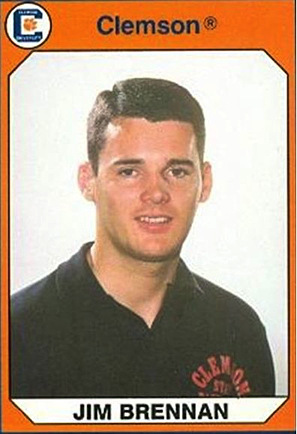
Here is a photo of my appearance-conscious freshman basketball coach Jim Brennan:
I did not even try out for the varsity basketball team the next year. I knew I was not good enough to get playing time. At best, I would have been practice fodder. Besides, I was becoming more attracted to the somewhat limited, in those days, social life at Clemson.
Overall, I would have to say that my basketball experience at Clemson was more fun and successful than my football experience. For one thing, I was able to associate with some people who became good friends. I was on the freshman team with Ritchie Mahaffey, our starting center. (No. 22 in the photo) His older brother Randy Mahaffey was on the varsity. About a year later, I was asked to join their fraternity, Delta Kappa Alpha.
All four Mahaffey brothers, Donnie, Randy, Tommy, and Richie, natives of LaGrange, Georgia, started for Clemson varsity basketball teams. A Mahaffey was a member of every Clemson basketball team between 1959-1970, the only time in ACC history four brothers from the same family played for the same program. One of the brothers led Clemson in rebounding for nine consecutive seasons between 1960-1968. In later business, they successfully sold construction and building materials to a growing Atlanta populace.
Another varsity basketball player, Jim Sutherland, was also in my DKA fraternity. Jim became a successful pediatric surgeon in Atlanta.
I grew a little closer to the two other freshman football teammates on the freshman basketball team, John Howell of Williston, SC, (second from left to right on the back row in the photo) and Bob Craig of Port St. Joe, Florida (No. 40 in the photo).
In the end, our relationship with other people is infinitely more important than our, or their, fleeting athletic accomplishments.